North Korea has announced plans to station new long-range artillery systems near the South Korean border this year while preparing to commission its first naval destroyer in the coming weeks.
The move signals another sharp rise in tensions on the Korean Peninsula as leader Kim Jong Un continues to strengthen the country’s military posture against South Korea and the United States.
The announcement arrived shortly after South Korea revealed that North Korea’s revised constitution no longer includes references to peaceful reunification. The constitutional changes reflect Kim’s push to formally establish a two-state system and abandon decades of rhetoric centered on Korean unity.
Kim Jong Un Inspects New Artillery Systems
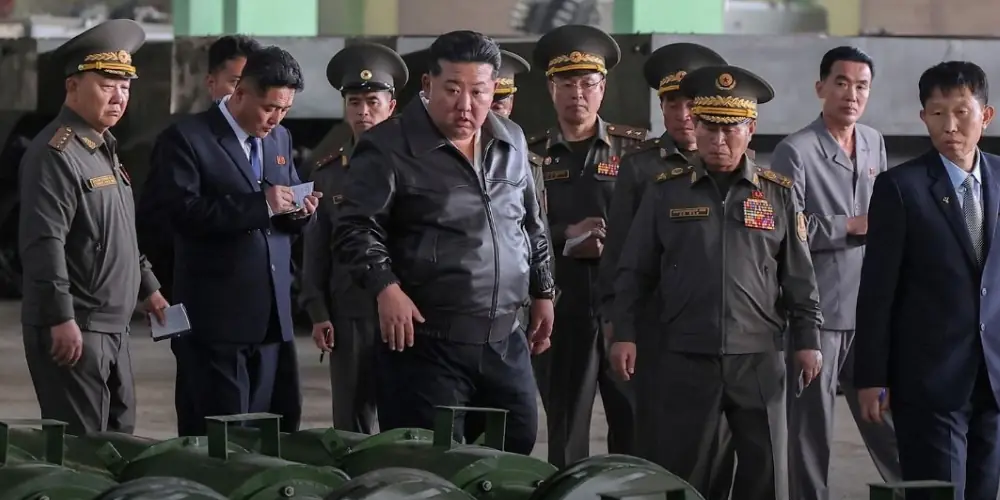
According to North Korea’s state-run Korean Central News Agency (KCNA), Kim Jong Un visited a munitions factory on Wednesday to inspect the production of 155-mm self-propelled gun-howitzers. The weapons are expected to be deployed to artillery units positioned near the southern border later this year.
KCNA reported that Kim described the artillery system as capable of striking targets beyond 60 kilometers, or roughly 37 miles. He stated that the upgraded weapons would create “a great change and advantage in the land operations of our army” due to their increased striking range and stronger combat capabilities.
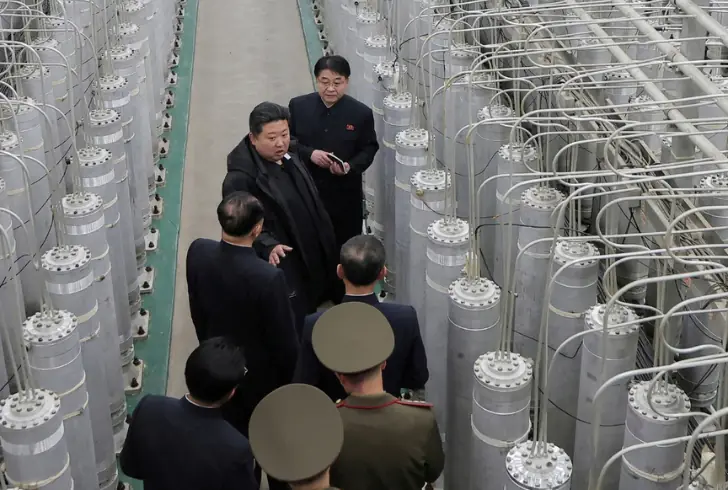
Kim also confirmed that North Korea plans to deploy additional tactical missile systems and multiple rocket launchers along the border area. While ballistic missile tests often draw international attention because they violate U.N. Security Council resolutions, North Korea’s artillery arsenal remains one of the country’s most immediate military threats.
Seoul, home to nearly 10 million residents, sits only about 40 to 50 kilometers from the heavily fortified border. Military analysts have long warned that North Korea’s artillery positions could cause extensive damage during a conflict.
First Destroyer Nears Commissioning
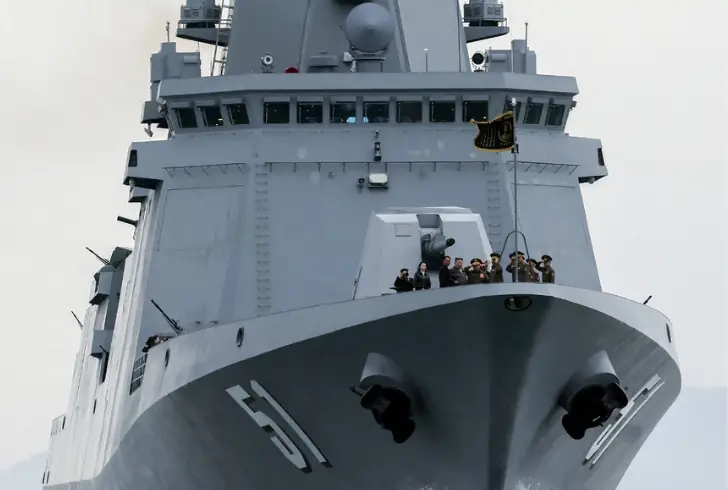
On Thursday, Kim inspected the destroyer “Choe Hyon” during naval exercises off North Korea’s west coast. KCNA said he reviewed the ship’s maneuverability and ordered officials to transfer the vessel to the navy by mid-June after praising the progress of operational tests.
The “Choe Hyon” became one of North Korea’s most closely watched military projects after its public debut last year. The warship is considered the country’s largest and most advanced destroyer to date.
North Korea later revealed a second destroyer from the same class, although the vessel reportedly suffered damage during a failed launching ceremony. Kim has since instructed authorities to build two additional destroyers, signaling a broader naval expansion effort.
Photos released by KCNA also showed Kim’s teenage daughter accompanying him aboard the destroyer. One image captured her standing behind her father while he addressed navy personnel, while another showed the pair sharing a meal with sailors on the ship. South Korea’s intelligence agency stated last month that she could potentially be viewed as Kim’s successor.
Constitutional Changes Deepen Division
South Korea said Wednesday that North Korea’s revised constitution now defines its territory strictly as the northern half of the Korean Peninsula. Earlier commitments tied to peaceful reunification with the South were removed entirely.
The shift follows Kim Jong Un’s January 2024 directive ordering constitutional revisions to erase the concept of shared statehood with South Korea. The decision marked a major break from policies supported by previous North Korean leaders, who publicly maintained long-term goals of reunification under Pyongyang’s control.
Kim has increasingly labeled South Korea as North Korea’s “permanent” and “most hostile enemy.” The tougher language has complicated efforts by Seoul’s liberal government to restart dialogue and lower tensions. South Korea had already taken several conciliatory steps, including shutting down border propaganda broadcasts in hopes of reducing military friction.
Relations between North Korea, South Korea, and the United States have remained frozen since nuclear talks between Kim Jong Un and President Donald Trump collapsed in 2019. Since then, Pyongyang has concentrated on expanding its nuclear arsenal, missile programs, artillery systems, and naval strength.
Recent military announcements, including the deployment of long-range artillery near Seoul and the commissioning of the “Choe Hyon” destroyer, reflect North Korea’s continued push to strengthen its defense capabilities.
At the same time, constitutional changes removing references to reunification signal a deeper political divide on the Korean Peninsula and rising regional tensions.