
Before NASA’s Artemis II astronauts left Earth for their journey around the Moon, something unusual was already inside the Orion spacecraft.
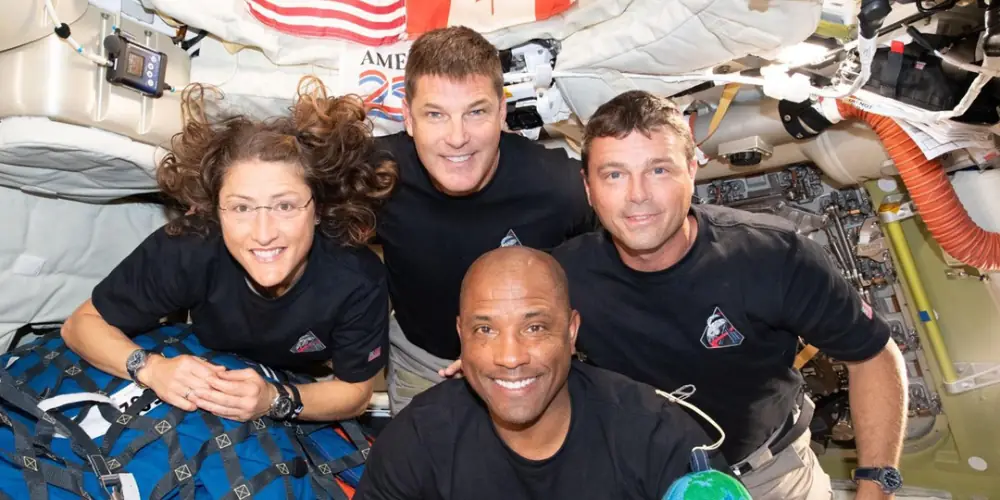
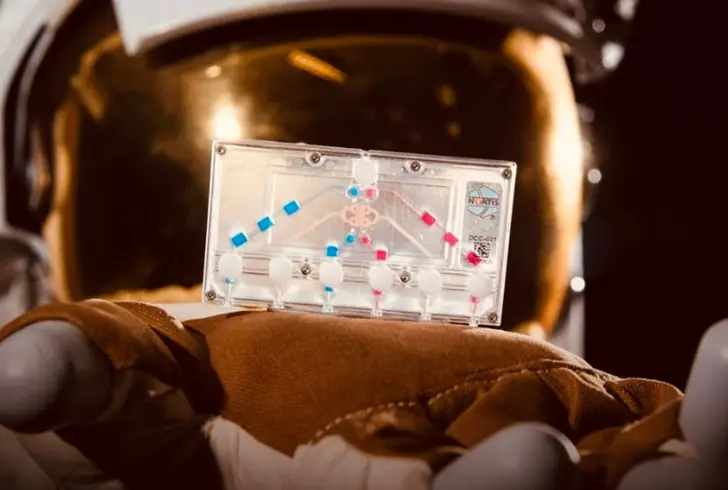
Alongside the crew of Reid Wiseman, Victor Glover, Christina Koch, and Canadian Space Agency astronaut Jeremy Hansen, tiny lab-grown “organ chips” were quietly stowed in a compact triangular container. Roughly the size of a USB drive, these biological samples carried a version of each astronaut’s own cells into deep space.
These miniature tissue systems are not symbolic payloads. They function as living test models designed to show how the human body reacts beyond Earth’s protective environment.
While the astronauts orbit the Moon, these chips are collecting biological data that could shape how humans live and travel far from Earth in the years ahead.
A Living Preview of Human Biology in Space
NASA refers to this experiment as AVATAR, short for A Virtual Astronaut Tissue Analog Response. The idea is straightforward but powerful: instead of waiting for post-flight medical tests, researchers can observe biological changes as they happen in space.
The organ chips are built using bone marrow tissue derived from cells donated by each Artemis II astronaut. That means each chip mirrors part of the astronaut’s immune system at a microscopic level. By studying these samples during flight, scientists can track how space conditions affect human biology in real time.
Lisa Carnell, Director of NASA’s Biological and Physical Sciences Division, highlighted the importance of this approach, noting, “We’ve never done this before.” The goal is to capture details that traditional studies often miss, especially subtle shifts that begin early during exposure to space radiation and microgravity.
Because the focus is bone marrow, the experiment centers on immune system behavior. This includes how cells respond to stress, radiation, and the absence of Earth’s protective atmosphere.
Why Bone Marrow Matters in Deep Space
Bone marrow plays a central role in producing blood cells and supporting immune defenses. In space, this system faces unusual strain. Radiation levels rise beyond Earth’s shielding, and the body adapts to microgravity in ways that are still not fully understood.
The AVATAR chips allow researchers to track these changes at a cellular level. Instead of broad medical snapshots taken before and after flight, scientists can see when and where biological shifts begin.
Carnell noted that each astronaut may respond differently to the space environment. Some may show resistance to radiation, while others may be more sensitive. That variation could lead to tailored medical support for future missions.
She explained that future deep space crews heading toward the Moon or Mars could carry personalized treatment kits based on this kind of data. These kits would help manage immune system stress during long-duration missions.
The Five Core Challenges of Space Travel
Space is not a gentle environment for the human body. NASA organizes the main risks under the acronym RIDGE, explained by Dr. Steven Platts, chief scientist for human research at NASA’s Johnson Space Center.
RIDGE stands for:
Radiation from solar and cosmic sources
Isolation from Earth and normal social environments
Distance from home, which limits emergency response
Gravity changes, including weightlessness
Environmental stress, both inside and outside the spacecraft
Even a short mission places pressure on the human body and mind. Artemis II, although lasting around ten days, provides a rare chance to observe how these factors interact inside a spacecraft far from Earth orbit.
Life Inside Orion
The Orion spacecraft, carrying the Artemis II crew, is roughly the size of a campervan. Compared to the International Space Station, which resembles a large multi-room home, Orion is compact and tightly shared.
Inside this small environment, astronauts sleep, eat, exercise, and work together continuously. That setup creates a unique setting for studying human behavior under pressure.
Dr. Platts emphasized interest in how the crew functions as a team in confined space. Communication, stress levels, and cooperation patterns all become part of the scientific data set. Even minor friction or fatigue patterns can provide insight for future missions to the Moon and Mars.
Tracking Health, Stress, and Immune Response
Beyond biological samples, Artemis II includes several tools to measure astronaut well-being throughout the mission.
Astronauts wear wrist devices similar to smartwatches. These monitors track movement patterns, sleep cycles, and activity levels. The data is compared with pre-flight and post-flight assessments to understand how space travel affects rest and recovery.
Mental health is also evaluated through structured questionnaires during different phases of the mission. These responses help researchers understand emotional shifts during long exposure to isolation and confinement.
Together, these tools form a detailed picture of cognition, stress response, and sleep quality in space conditions.
One of the most practical biological monitoring methods used in Artemis II involves saliva sampling. Astronauts collect saliva before, during, and after the mission. Since Orion does not include refrigeration, the samples are stored by blotting saliva onto special paper kept in compact booklets.
These samples help researchers study immune system activity and stress response. They also allow scientists to check whether dormant viruses, such as those linked to chickenpox and shingles, reactivate in space. Similar reactivations have been observed during missions aboard the International Space Station.
This type of data provides a clearer picture of how spaceflight influences immune stability over time.
Spaceflight Health Tracking and Monitoring
Artemis II is also part of the Spaceflight Standard Measures study, a program running since 2018. It tracks astronaut health across multiple missions, not just single flights.
Before launch, the crew provided blood, urine, and saliva samples. These samples help establish baselines for nutrition, cardiovascular health, and immune function. Additional tests measure balance, vision, brain function, muscle strength, and microbiome changes.
During flight, astronauts report motion sickness symptoms and other physiological changes. After return, they undergo follow-up assessments that track recovery across multiple systems in the body.
Radiation exposure is measured using six sensors placed throughout Orion. Each astronaut also carries a personal radiation monitor, kept in a pocket for continuous tracking. These systems provide alerts if radiation levels rise to unsafe thresholds, such as during solar flare events.
Returning to Earth

After splashdown, astronauts do not immediately return to normal activity. Instead, they go through a structured “obstacle course” designed to test physical recovery.
This includes tasks like climbing ladders, lifting objects, and performing coordinated movements. The goal is to evaluate how quickly the body adjusts back to Earth’s gravity after days in microgravity.
Dr. Platts explained that the inner ear is especially affected during space travel. Balance systems can take several days to stabilize after return. Recovery typically takes three to five days, but early movement challenges provide important insight for future lunar missions.
On the Moon, astronauts will need to operate without assistance after landing, making this recovery data essential for mission planning.
Artemis II Expands Space Health Research
Lakiesha Hawkins, acting deputy associate administrator for NASA’s Exploration Systems Development Mission Directorate, noted that Artemis II introduces a level of human health tracking not seen during the Apollo era.
Earlier lunar missions collected limited biological data. Artemis II expands that scope significantly, offering continuous monitoring before, during, and after flight.
This information supports long-term goals, including sustained lunar presence and future missions to Mars. Understanding how the body responds over time in deep space is central to planning safe and effective exploration strategies.
The organ chips aboard Artemis II represent a shift in how human spaceflight is studied. Instead of relying only on pre- and post-mission tests, NASA now observes living tissue responses during the journey itself.
Combined with real-time health tracking, radiation monitoring, and behavioral analysis, the mission provides one of the most detailed human spaceflight datasets ever collected.
From bone marrow-based AVATAR chips to saliva samples and sleep tracking devices, every layer of the Artemis II mission contributes to a clearer understanding of how the human body adapts beyond Earth. As NASA prepares for longer missions to the Moon and eventual travel to Mars, this data forms a critical foundation for keeping astronauts healthy far from home.